Dislocated Tailbone: Symptoms, Diagnosis and Treatment
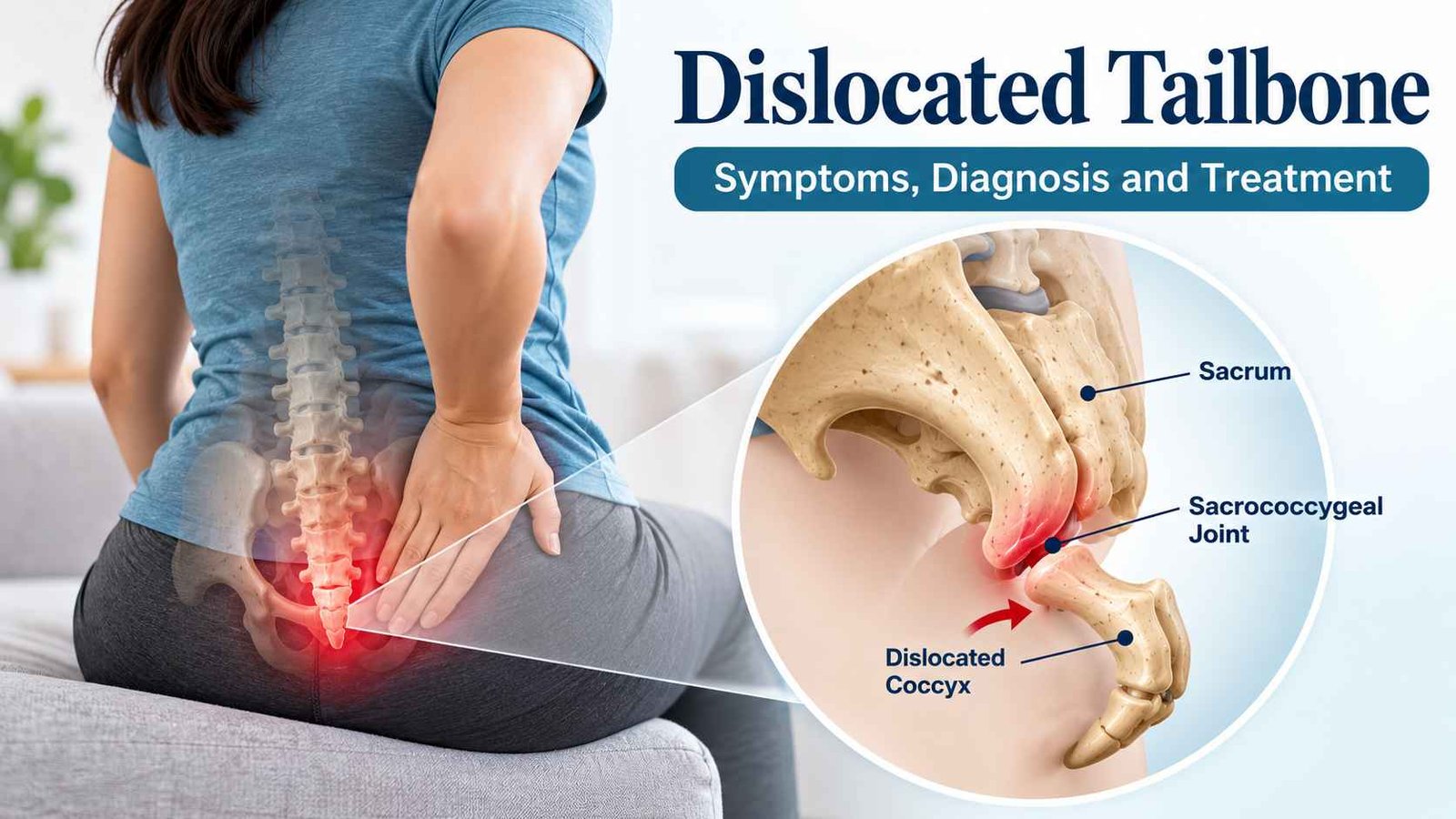
A dislocated tailbone occurs when the coccyx, the small bone at the bottom of the spine, becomes displaced at one of its joints. Unlike general tailbone pain, a true coccygeal dislocation involves a structural change that may require specific clinical evaluation.
A dislocated coccyx can cause localized pain, particularly when sitting or moving from a seated to a standing position. However, these symptoms can also occur with other tailbone conditions, so pain alone cannot confirm a dislocation.
Although coccygeal dislocation is uncommon, understanding its symptoms, diagnostic methods, and treatment options can help patients recognize when specialist assessment is appropriate.
This guide focuses specifically on coccyx dislocation, how it differs from a tailbone fracture or ordinary coccydynia, and what patients should know about diagnosis, management, and recovery.
Table of Contents
What Is a Dislocated Tailbone?
What Happens When the Coccyx Becomes Dislocated?
Dislocated Tailbone Symptoms
Dislocated Tailbone vs. Fractured Tailbone
How Is a Dislocated Tailbone Diagnosed?
Dislocated Tailbone Treatment Options
Can a Dislocated Tailbone Heal Without Surgery?
How Long Does a Dislocated Tailbone Take to Heal?
What Should You Avoid With a Suspected Tailbone Dislocation?
When Should You Seek Medical Attention?
Frequently Asked Questions
What Is a Dislocated Tailbone?
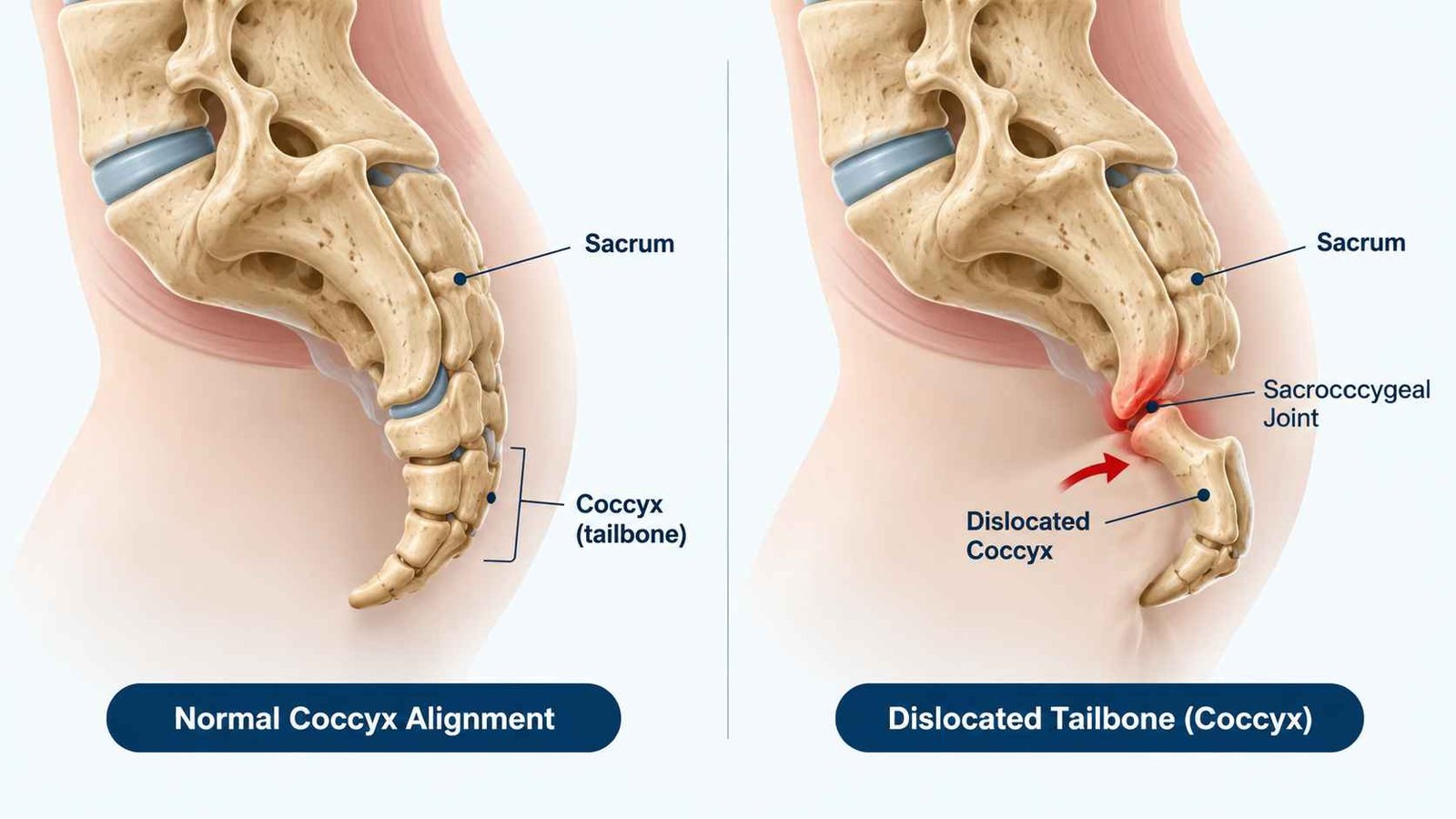
A dislocated tailbone, also known as coccygeal dislocation, refers to displacement of the coccyx at a joint connecting its bony segments or at the sacrococcygeal joint, where the coccyx meets the sacrum.
The coccyx is usually composed of several small vertebral segments, some of which may be fused. Its anatomy and mobility vary between individuals.
A dislocation differs from a fracture because the primary abnormality involves the alignment of a joint rather than a break in the bone. However, fractures and dislocations can sometimes occur together.
Is Tailbone Dislocation the Same as Tailbone Misalignment?
Not necessarily.
The term tailbone misalignment is sometimes used informally to describe an abnormal coccygeal position. However, an unusual coccyx shape or angle does not automatically indicate a true dislocation.
Some anatomical variations are normal, while other findings may represent joint instability, subluxation, or displacement.
A specialist must interpret imaging findings alongside the patient’s symptoms and clinical examination before making a diagnosis.
For patients experiencing persistent pain without a confirmed structural injury, our guide to coccydynia and tailbone pain treatment explains the broader condition.
What Happens When the Coccyx Becomes Dislocated?
The coccyx is connected to the sacrum and surrounding structures through joints, ligaments, and soft tissues.
When a true dislocation occurs, the normal relationship between the affected joint surfaces is disrupted.
This may produce pain because of injury or irritation involving the joint and surrounding tissues.
Displacement at the Sacrococcygeal Joint
The sacrococcygeal joint connects the sacrum to the coccyx.
Displacement at this joint can alter the position of the coccyx relative to the sacrum.
Displacement Between Coccygeal Segments
Some coccygeal segments retain movement between them.
Abnormal displacement may occur at one of these joints, depending on the individual’s anatomy.
Why the Direction of Displacement Matters
A displaced coccyx may be described according to the direction of its abnormal position.
However, the clinical significance depends on the specific anatomy, imaging findings, symptoms, and whether the displacement is fixed or associated with abnormal movement.
The direction of displacement alone does not determine the most appropriate treatment.
Dislocated Tailbone Symptoms
A dislocated tailbone may cause symptoms similar to other coccygeal injuries.
Commonly reported symptoms can include:
Localized pain near the bottom of the spine.
Tenderness over the coccyx.
Pain that increases when sitting.
Discomfort when moving from sitting to standing.
Pain with direct pressure over the tailbone.
Difficulty tolerating certain seated positions.
Some patients may also experience discomfort during activities that place pressure on the coccygeal region.
Can You Feel a Dislocated Tailbone?
Some individuals may notice unusual tenderness or a change in the contour of the tailbone region after an injury.
However, the coccyx normally varies in shape and position between individuals.
Feeling a bump or experiencing tenderness does not reliably confirm a dislocation.
Attempting to identify or reposition a suspected dislocation by pressing on the area is not recommended.
Can a Dislocated Tailbone Cause Pain While Standing Up?
Yes. Pain during the transition from sitting to standing can occur with coccygeal disorders, including certain forms of instability or displacement.
However, this symptom is not specific to dislocation and can also occur with other causes of coccydynia.
A diagnosis requires more than the presence of this symptom.
Dislocated Tailbone vs. Fractured Tailbone
A tailbone dislocation and a tailbone fracture are different injuries, although their symptoms may overlap.
| Feature | Dislocated Tailbone | Fractured Tailbone |
|---|---|---|
| Main abnormality | Displacement at a coccygeal joint | Break in one or more coccygeal bones |
| Possible symptoms | Localized pain, tenderness, pain with sitting | Localized pain, tenderness, pain with sitting |
| Diagnosis | Clinical assessment and appropriate imaging | Clinical assessment and imaging when indicated |
| Treatment | Depends on displacement, symptoms, and clinical findings | Depends on fracture characteristics and symptoms |
| Surgery | Uncommon; considered only in selected circumstances | Uncommon; considered only in selected circumstances |
Can a Tailbone Be Both Fractured and Dislocated?
Yes. A significant injury may involve both a fracture and joint displacement.
This is sometimes described as a fracture-dislocation.
The treatment plan depends on the injury pattern, associated symptoms, and specialist assessment.
For detailed information about fractures specifically, read our existing article on fractured tailbone symptoms, treatment, and recovery.
How Is a Dislocated Tailbone Diagnosed?
Diagnosing coccygeal dislocation requires an appropriate clinical assessment.
A healthcare professional evaluates the symptoms, circumstances of the injury, examination findings, and whether imaging is necessary.
Medical History and Symptom Assessment
The clinician may ask:
Did the pain begin after a fall or direct impact?
Is the pain localized to the coccyx?
Does sitting increase the discomfort?
Are symptoms improving, remaining unchanged, or worsening?
Have similar symptoms occurred previously?
These details help determine whether a structural injury should be considered.
Physical Examination
The examination may include assessment of localized tenderness, visible injury, and other relevant findings.
The clinician also considers whether symptoms could originate from another anatomical structure.
X-Ray Imaging
X-rays may help identify certain fractures, dislocations, or abnormalities in coccygeal alignment.
However, routine imaging is not necessary for every patient with tailbone pain.
The decision to obtain imaging depends on the clinical situation.
Dynamic Sitting and Standing X-Rays
In selected patients with persistent coccydynia, specialists may use lateral radiographs obtained in sitting and standing positions to assess abnormal coccygeal movement.
These studies may help identify hypermobility, instability, or positional displacement that is not evident on a standard image.
Dynamic imaging is not routinely required for every suspected injury, and its interpretation requires relevant expertise.
MRI or CT Scan
MRI or CT may be considered when the clinical findings warrant further investigation.
These tests can provide additional information about bone, surrounding tissues, or alternative causes of symptoms.
The appropriate investigation depends on the suspected diagnosis.
Our diagnostic services page provides more information about evaluating tailbone-related conditions.
Dislocated Tailbone Treatment Options
Dislocated tailbone treatment depends on whether the coccyx is truly displaced, how severe the symptoms are, and whether other injuries are present.
A confirmed dislocation does not automatically require surgery or manual repositioning. Many patients with coccygeal injuries can be managed conservatively under medical supervision.
Initial Management After a Suspected Dislocation
Following an injury, the immediate priority is to avoid further pressure or trauma to the coccyx.
A healthcare professional may recommend:
Temporarily modifying activities that aggravate the injury.
Reducing direct pressure on the tailbone when sitting.
Using appropriate pain relief, when medically suitable.
Monitoring symptoms and functional improvement.
Arranging further assessment if symptoms persist or worsen.
These measures help manage symptoms but do not necessarily restore joint alignment.
Conservative Treatment for Confirmed Dislocation
For patients without complications requiring urgent intervention, a clinician may recommend non-surgical management.
The treatment plan may involve pressure reduction, appropriate medication, gradual activity modification, and follow-up assessment.
If symptoms remain persistent, the clinician may consider physiotherapy or other interventions based on the diagnosis.
Conservative management is generally preferred initially, although the approach should be individualized. A 2025 medical review discusses the available management strategies for coccygeal fracture-dislocation.
Can a Doctor Reposition a Dislocated Tailbone?
In selected circumstances, a specialist may consider whether reduction or another procedure is appropriate.
However, manual repositioning is not routinely required for every coccygeal dislocation, and evidence supporting specific reduction techniques is limited.
The decision depends on the type of displacement, symptoms, associated injuries, and specialist judgment.
Patients should never attempt to push, pull, or manipulate the coccyx into position themselves.
What if Pain Continues Despite Treatment?
Persistent symptoms require reassessment rather than repeated attempts at self-treatment.
A clinician may review the original diagnosis, consider whether abnormal coccygeal movement is contributing to pain, and determine whether further imaging or specialist interventions are appropriate.
For a more detailed discussion of conservative treatment approaches, read our article on tailbone pain treatment without surgery in Bangalore.
Can a Dislocated Tailbone Heal Without Surgery?
Yes. Some patients with a dislocated coccyx improve without surgery.
However, improvement in pain does not always mean that the coccyx has returned to its previous anatomical position.
The body may adapt to certain structural changes, and symptoms can improve even when imaging continues to show an abnormal alignment.
Does Every Dislocation Need to Be Corrected?
No. Treatment is based on the patient’s symptoms, functional limitations, injury characteristics, and clinical findings.
An abnormal coccyx position on imaging does not automatically require correction.
When Might Surgery Be Considered?
Surgical treatment is uncommon and generally reserved for carefully selected patients with persistent, function-limiting pain despite appropriate non-surgical management.
The decision requires specialist evaluation and consideration of whether the coccyx is genuinely responsible for the ongoing symptoms.
Our separate article on tailbone surgery (coccygectomy) explains surgical decision-making in greater detail.
How Long Does a Dislocated Tailbone Take to Heal?
There is no single recovery timeline that applies to every coccygeal dislocation.
Recovery depends on several factors, including:
The extent of joint displacement.
Whether a fracture or other injury is also present.
The severity and duration of symptoms.
Individual healing characteristics.
The response to treatment.
Early Recovery
During the initial period, discomfort may gradually improve as injured tissues recover.
Patients may still experience tenderness when sitting or placing pressure on the coccyx.
Persistent Symptoms
Some individuals experience pain lasting several weeks or longer.
Persistent pain does not necessarily indicate that the coccyx remains dislocated, and repeat assessment may be needed to determine why symptoms continue.
When Recovery Takes Longer Than Expected
If pain is not improving, interferes substantially with daily activities, or becomes worse, a healthcare professional should reassess the condition.
Recovery should be evaluated according to symptoms and function rather than a fixed deadline.
What Should You Avoid With a Suspected Tailbone Dislocation?
Certain activities and self-treatment techniques may aggravate a suspected injury.
Avoid Attempting to Reposition the Coccyx
Do not try to push a suspected dislocated tailbone back into place.
Untrained manipulation may worsen pain or injure surrounding tissues.
Avoid Forceful Tailbone Massage
Deep pressure directly over a recently injured coccyx may aggravate symptoms.
Massage should not be used as a method of correcting a suspected dislocation.
Avoid Repeatedly Testing the Painful Area
Pressing on the coccyx to check whether it has moved can increase tenderness without providing a reliable diagnosis.
Avoid Ignoring Persistent Symptoms
If pain remains significant or worsens, seek appropriate assessment instead of assuming that the injury will resolve without evaluation.
When Should You Seek Medical Attention?
Medical evaluation is advisable when tailbone pain follows a significant injury or when symptoms raise concern about a structural abnormality.
Seek assessment if:
Pain began after a fall or direct impact.
Localized coccyx pain is severe or worsening.
Sitting or routine activities remain difficult.
Symptoms persist despite appropriate initial care.
A clinician suspects a fracture, dislocation, or another underlying condition.
Symptoms Requiring Urgent Assessment
Seek emergency medical attention if pain is accompanied by:
New loss of bladder or bowel control.
Difficulty passing urine.
Numbness around the groin or saddle area.
New or progressive leg weakness.
These symptoms may indicate a serious neurological problem and should not be attributed to a simple tailbone dislocation.
Frequently Asked Questions
1. What Does a Dislocated Tailbone Feel Like?
A dislocated tailbone may cause localized pain, tenderness, and discomfort when sitting or changing position. However, these symptoms also occur with other coccygeal conditions, so they cannot confirm dislocation.
2. How Do You Know if Your Tailbone Is Dislocated?
A clinician evaluates your medical history, symptoms, and examination findings. Imaging may be recommended when a structural injury is suspected. You cannot reliably diagnose coccygeal dislocation by touch alone.
3. How Do You Treat a Dislocated Tailbone?
Treatment usually begins with an individualized non-surgical approach, such as reducing pressure on the coccyx, appropriate pain management, and clinical follow-up. Persistent or complicated cases may require specialist evaluation.
4. Can a Dislocated Tailbone Fix Itself?
Symptoms may improve without surgical intervention, even when some anatomical displacement remains. However, a dislocated coccyx does not necessarily return to its original position spontaneously.
5. Can a Chiropractor Fix a Dislocated Tailbone?
There is insufficient evidence to recommend chiropractic manipulation as a reliable method of correcting a true coccygeal dislocation. A suspected structural injury should be assessed by an appropriately qualified medical professional before manipulation is considered.
6. Is It Safe to Walk With a Dislocated Tailbone?
Some patients can walk comfortably despite coccygeal pain. However, activity recommendations depend on the injury and whether other structures are involved. Severe pain or difficulty walking after trauma requires medical assessment.
7. Can a Dislocated Tailbone Cause Permanent Pain?
Some patients develop persistent coccydynia following coccygeal injury, but permanent pain is not inevitable. Appropriate assessment and individualized management can help identify factors contributing to ongoing symptoms.
8. Does a Dislocated Tailbone Always Need Surgery?
No. Surgery is uncommon and is generally considered only in selected cases where persistent symptoms have not responded adequately to appropriate treatment.
Conclusion
A dislocated tailbone is a structural abnormality involving displacement at a coccygeal joint. Although it can produce pain and tenderness, its symptoms overlap with those of other tailbone conditions.
Accurate diagnosis is important because an unusual coccyx position, fracture, joint instability, and general coccydynia are not necessarily the same condition.
Many patients improve with appropriate non-surgical management, while persistent or complicated cases may require further specialist evaluation.
If you are experiencing persistent tailbone discomfort or suspect a structural injury, contact our clinic to discuss appropriate evaluation and management options.
Medical disclaimer: This article is for educational purposes only and does not replace professional medical advice, diagnosis, or treatment.